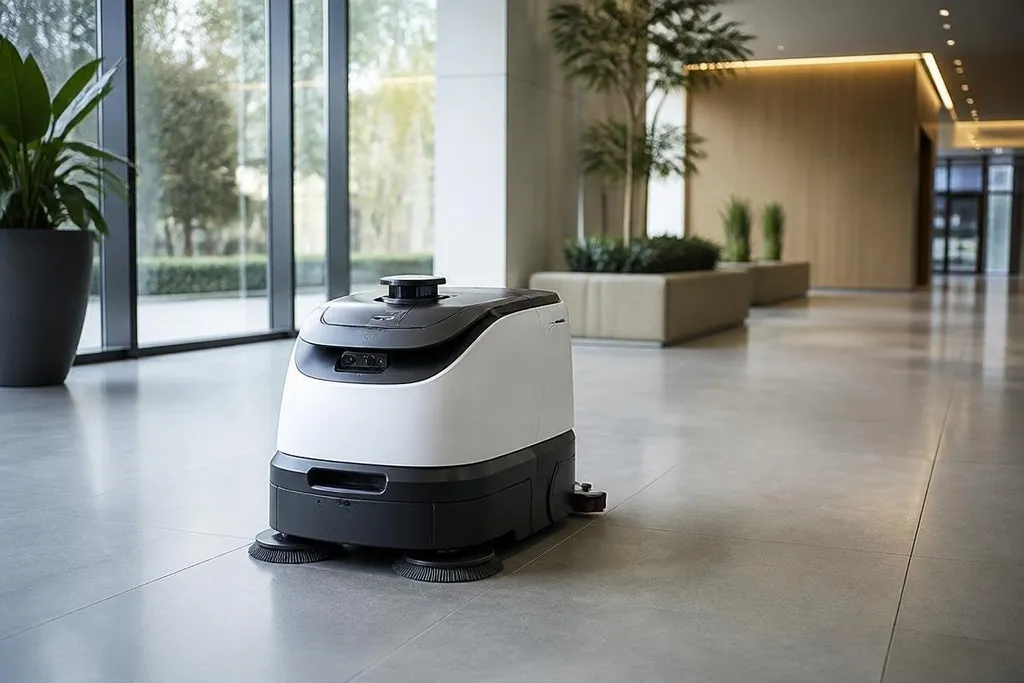
A cleaning robot can now handle repeat work such as vacuuming, mopping, and floor checks without waiting for a person to start each task. That makes the category useful for homes, offices, hotels, stores, and other sites where clean floors need regular attention.
Quick read
- Repeated floor work suits robots because the task follows set routes.
- Mapping, obstacle sensors, and docking reduce the need for constant supervision.
- The hard part remains deep cleaning, clutter, stairs, and safe operation around people.
Repeated work fits automation
Cleaning has a feature that suits automation: much of it happens in the same places, in a similar order, every day. A robot can use sensors to map rooms, plan a route, and return to areas that still need work.
That changes the labor needed for routine floor care. A person can spend less time on open floor space and more time on edges, spills, stairs, furniture, or rooms the robot cannot enter. The value comes from task coverage, not from making the robot do every part of cleaning.
Vacuuming and mopping are also easy to schedule. A robot can run after closing time or during quiet hours, which helps sites avoid sending staff through the same area several times during a shift. The schedule still needs checking because a blocked path can stop the job.
Sensors make daily use less demanding
Daily operation needs more than wheels and a motor. Cameras, LiDAR, bump sensors, or other distance sensors help it find walls, furniture, drop-offs, and people. Mapping software turns those readings into a route the robot can use again.
Docking adds another useful step. When the battery runs low, the robot can return to its dock to charge. Some models can also empty a dust bin or refill cleaning fluid at the dock, but those functions depend on the model and the site setup.
These systems reduce routine supervision, but they don't remove it. Cables, loose clothing, toys, chairs, wet patches, and newly moved furniture can still change the route. A cleaning plan works best when the floor remains ready for the robot.
A clear floor turns a cleaning robot’s route into a testable task: how often it finishes, where it stops, and how much human help it needs. Dated reporting on Robot 24 can put those details beside named machines and test settings before the next section looks at why buyers see a clearer use case.
Why buyers see a clearer use case
The strongest case is a site with large floor areas and repeat cleaning needs. A hotel corridor, supermarket aisle, airport passage, or office floor gives the robot a defined job and a clear route.
A robot can also record where it worked, when it ran, and whether it stopped. That record helps a manager check missed areas and adjust the schedule. It doesn't prove that the floor is clean, so visual checks still matter in high-use spaces.
The cost decision depends on more than the purchase price. Buyers need to include docking equipment, software fees if any, floor preparation, service, replacement parts, and the time staff spend clearing problems. A low purchase price can lose its appeal if the robot needs frequent help.
I’d buy one for repeat floor work in a site that can keep routes clear; I’d skip it for a cluttered building with many stairs.
Where cleaning robots still fall short
Robots work best on open floors. They are less useful around tight furniture, changing layouts, thick thresholds, stairs, narrow corners, and rooms that need close human inspection.
They also have limits in cleaning power. A robot can collect dust or spread cleaning fluid across a route, but heavy stains, spills, gum, grease, and waste still need a person with suitable equipment.
A machine that runs often may keep dust under control while leaving harder jobs untouched.
Safety needs a site plan. Staff must know where the robot runs, how to stop it, and what to do when it blocks a walkway. The robot should also have a clear charging area and a route that doesn't force people to step around it.
A practical buying check
Use this list before asking for a quote:
- Map the floor: Record open areas, stairs, thresholds, lifts, tight corners, and places where people gather.
- Define the task: Decide if the robot will vacuum, mop, scrub, inspect floors, or handle a mix of jobs.
- Count interruptions: Watch how often cables, boxes, furniture, or people would block its route.
- Price the full setup: Add the dock, service, parts, software, staff time, and any changes to the floor area.
- Set a proof run: Test one defined area and check cleaning results, stops, recovery time, and staff workload.
The proof run should answer one practical question: does the robot remove enough repeat work to earn its place on that floor? Until a machine passes that test, popularity is a weak reason to buy one.